
Technology
Foundations of a Performing Team


What defines a good team? The "Foundations of a Performing Team" is our shared answer to that question, co-created by our people. A shared map towards excellence.
How many times have you heard comments such as ”This team isn’t working well”, ”That team isn’t mature enough”, ”The business is not happy with their results“?
What you should consider when you hear comments like that is:
- Opinions vary a lot depending on the interlocutor
- When opinions are aligned, what varies are the reasons why, for each interlocutor, a team is or isn’t working well
We’ve experienced similar situations, so we wanted to see if we could remove some subjectivity when looking at the performance of a team.
The Workshop
We (a subset of our Product Owners, Software Engineers, Software Engineers in Test, Site Reliability Engineers, Experience Designers, Architects) gathered together for a workshop and asked ourselves the following question: ”A team delivered a product increment and the iterations that led to it were flawless as well as the delivery and everything that happened afterwards. Everybody noticed the outstanding job, from the CEO to the developers, from SREs to the Product Owners! What behaviours could you have observed over that time?”
Divided into groups we tried to answer the question, we shared the output of our conversations, clustered the answers and refined them. We then derived some Core Values, that we were also able to easily tie to our Company Values.
Once the workshop was over and the outcomes tidied up, we asked our leadership team (Chief Product Officer, Chief Technology Officer and other managers) to have a look at the contents created bottom-up, and they provided valuable input mentioning additional behaviours that they wish to see in the teams.
The Output
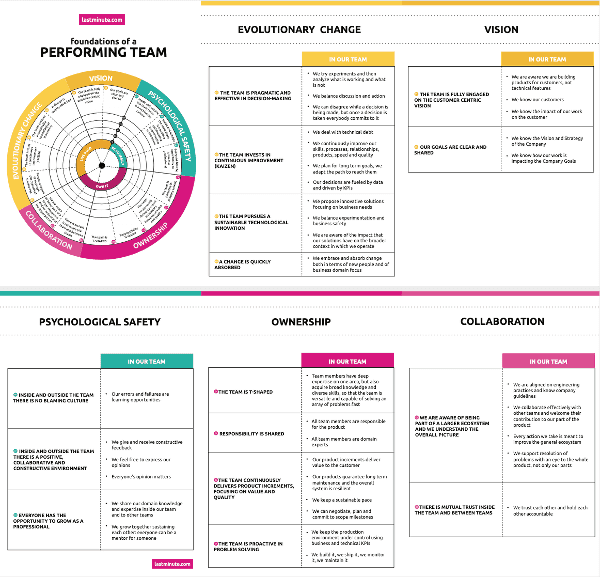
We called the output of that work “Foundations of a performing team”, and we designed it as a framework for alignment and self-assessment purposes.
It is valid for us, of course it is not a universal framework: is our shared map towards excellence as a team, co-created by our people.
Those are the foundations: performance is built on them.
Why focus on the Team?
”If you want to go fast, go alone. If you want to go far, go together.”
In the complex context of Product Development, ”yourself” it is not the place where value for the customer can be created in a sustainable way: you need the team, where a bunch of t-shaped people closely collaborate towards a shared goal.
When we say “Team” we are including every team member: not just Software Engineers, but also the Product Owner, Experience Designers if any, Copywriters if any, Data Analysts…everybody who is actively contributing to achieving the goals of the team is supposed to contribute to the self-assessment.
What’s in it and how we use it
Download it!
Radar
In the outer circle of the Radar you see the Core Values of a performing team (that are linked to our Company Values in the inner circle), with a brief explanation for each of them.
The Radar is meant for self-assessment purposes:
- print it out
- rate your performance as a team and mark your numbers on the radar, drawing a spider diagram
- decide what is the area where to focus improvement efforts
- identify improvement actions and follow-up on them
- repeat a couple of times per year, and observe your trend of Continuous Improvement over time
Tables
The Tables are meant to provide examples of observable behaviours for each value (they are not intended as checklists, but as triggers of the conversation).
Please note that what is most important here is not the rating itself, but:
- The conversation that unfolds
- The trend over time
Lessons Learned
Are we flawless in the way in which we operate, after the introduction of the “Foundations of a performing team”?
Does every team hold such a retrospective twice per year?
Is everybody aligned to it?
Of course not. But it’s ok!
Because now we have a common direction to tend to and a tool that can help us in several ways:
- Align expectations on the teams and minimise misunderstandings
- Understand the cultural fit of a candidate during interviews
- Support the decision-making process, also from an individual perspective
- A new team that is forming can gather around the guidelines to maximise shared understanding
- Team Managers and the Leadership team have the mandate to create the context to make those behaviours happen, foster them and remove impediments along the way
- The framework is intended for the team, but every individual in the team can, of course, look up to it to check from time to time if she is still onboard
We know that a tool is not a magic wand! The key to success is the mindset and this tool helps us grow the mindset we want.
Read next


From Months to Weeks: The Smart Way to Let AI Do a Migration


How we migrated 137 modules to a new dependency-injection pattern with AI, turning a quarter-long slog into a few focused weeks by teaching the AI instead of delegating to it, working in small supervised steps, and letting the method compound. [...]


Written by lastminute.com folks, who live for the holidays. You should follow us on Twitter.


Want to express your love for travel and tech? Well, you could read another article, or you could just come and join us. We’re always looking for talent to help us enrich the lives of travellers - find your role here.
The postings on this site are authors' opinions and experiences and do not necessarily represent the postings, strategies or opinions of lastminute.com group.